

Devoted Lehman-heads may have noted that in the past couple of months, I’ve spent a lot of time tweeting, talking, and writing about Flock cameras, the automatic license plate readers sold by Flock Safety. An ALPR is what it sounds like: a camera that records license plates as they pass, creating a record of what cars were seen by what cameras at what times. ALPRs are not a new technology—police departments have been using them in the United States since the turn of the millennium, and two-thirds of big (> 100 officers) departments had them by 2016. But they’ve attracted immense backlash in recent months, with particular focus on Flock’s network of ~120,000 networked cameras, used by something like 5,000 police departments.
The sources of the backlash are myriad, but the legitimate ones pertain to fears of abuse and privacy. The abuse concerns stem from stories about officers using the cameras for purposes other than the enforcement of the law, especially to stalk exes or other people. As my colleague Rafael A. Mangual and I have argued, to the extent that this represents a significant problem, it is best addressed through intelligent regulation—logging, auditing, and criminal penalties for misuse, among other approaches—not through bans.
The privacy concerns are, in essence, that Flock’s ALPR network constitutes “mass surveillance” or a “dragnet”—a system of indiscriminate surveillance which allows the tracking of Americans’ every move. This is standard rhetoric from critics. Thomas Massie analogized the deployment of ALPRs to 1984, while a Reason headline claimed that “America Is Building a Surveillance State Like China’s.” Most recently, U.S. district judge Sara E. Hill of the Northern District of Oklahoma ruled that the Tulsa County sheriff’s office’s use of a Flock system amounted to “indiscriminate mass surveillance” prohibited by the Fourth Amendment.
Police, to be fair, sometimes use such language themselves. Norfolk, Virginia’s police chief claimed that “it would be difficult to drive anywhere of any distance without running into a camera” in the city. Flint’s police chief has promised to “blanket” the city with cameras, while a deputy chief of the Johnson City, Tenn., police said “we want the whole city to be covered” with ALPRs and other cameras.
There are, to be sure, a lot of Flock cameras. That’s true nationwide, but also in major cities like Houston and Atlanta. But there are, well, also a lot of roads in the United States—4.2 million miles of them. So does Flock’s ALPR system actually permit “mass surveillance”?
The answer is definitely “not yet” and plausibly “never.” There are systems that may well permit the kind of all-seeing surveillance that Flock critics blame it for. But the data tell me that ALPRs just aren’t that. Rather, ALPRs seem currently to be deployed in a limited fashion, consonant with maximizing safety benefits while minimizing privacy risks. If Flock critics disagree, they need to go beyond quoting cops and Flock execs and actually show, numerically, that Flock’s system can see a lot of what we do.
While this isn’t necessarily a post about the law, it’s helpful to anchor the conversation in how the law treats public surveillance generally. As Mangual and I explain, courts have conventionally asserted that Americans have no “reasonable expectation of privacy” as to their movements on public roads and as to the exterior of their vehicle. Indeed, it would be prima facie ridiculous to assert that cops can’t look at what you’re doing not just in public, but driving on publicly owned roads using a license plate owned by the government.
That said, a recent line of cases has established a reasonable expectation of privacy as to the “whole of a person’s movements.” These cases pertain, variously, to GPS tracking; tracking using pings to cellphone towers; and tracking of a person’s Google location history. In all three, a majority of the Court concluded that the granularity of information the system was capable of collecting—over 100 pings per day in the cell tower case, e.g.—constituted a violation of privacy rights, therefore triggering the Fourth Amendment’s warrant requirement.
Bracketing what the Fourth Amendment actually means,1 I think this is not a crazy account of privacy as policymakers should think about it. It’s one thing for the police to be able to look at where you are on the road at certain times and places. It’s another for them to know everywhere you go, all the time. Clearly the latter is much more invasive!
The challenging question, when it comes to ALPRs, is whether they are the kind of system that can accomplish that goal—of knowing everywhere you go, all the time. Critics tend to rely on claims by Flock and police that make it sound like the answer is yes. But that’s a terrible way of doing the analysis. Flock has a pecuniary reason to overstate its own efficacy, and cops are not necessarily expert quantitative analysts. Instead, it’s probably better to try to do some estimates of the actual density of ALPRs.
One method of doing this is to ask: how much of the road can ALPRs see? A GPS tracker or cell tower can effectively “cover” a lot of the road. But what percentage of movement on the roads can ALPRs observe? We do some math on this in our report:
Even in jurisdictions with relatively expansive ALPR coverage, the overwhelming majority of road space falls outside the sight picture of a network of standard ALPRs. Start with the fact that that the stationary ALPR cameras made by the most popular provider of these products as of this writing—Flock Safety—have a sight picture that is approximately 75’ x 20’ (or 1,500 SqFt). In essence, this amounts to 1.5 standard traffic lanes over a 75-foot distance. By comparison, there are roughly 4.2 million miles of roadway in the United States.
Nor are ALPRs particularly dense in cities where they are deployed. Consider the city of Houston, Texas, which had, according to a June 2024 Houston Chronicle report, more than 3,800 ALPR cameras operating within the city. The city, according to Houston Public Works, has approximately 16,000 lane miles within its limits, which amounts to just over one billion square feet of roadway—not including highways maintained by the state and county but within the city limits. Assuming the city is currently operating 4,000 ALPR cameras with 75’ x 20’ sight pictures, those cameras cannot see more than six million square feet—less than one percent of the total square footage of Houston’s roadways.
You can do this math repeatedly in major cities, and the story is pretty consistent: ALPRs generally cover less than 1 percent, and usually less than 0.5 percent, of road area. It’s very hard to observe the whole of a person’s movements with such a small total picture.
Of course, not everyone finds this argument convincing. Institute for Justice2 attorney Josh Windham, responding to Mangual and me making this case, offers a sterling example:
The notion that mass warrantless ALPR surveillance is fine because “ALPRs can see only a fraction of the roads in a given jurisdiction,” should not fool anybody.
Nobody who opposes this kind of mass surveillance is concerned about the percentage of pure roads ALPRs photograph.
Our concern is rather that roads are integrated and indispensable travel networks. So if cameras capture a person at points A, B, C, ad infinitum, the government can learn a lot more about him than the mere fact that he was on a few isolated patches of road at a few isolated point in time.
That is not an incidental feature of these ALPR systems—it is an essential part of how the major players pitch their own products to the government: Hey look, we can create maps of where drivers have been! We can find out who drivers associate with! We can learn where they commonly visit!3
He’s not the only one to make this argument, of course. And there’s an appealing logic to it: even if Flock cameras see a small area around them, you can stitch together the lines between Flock cameras and draw inferences about the whole of a person’s movements. If you imagine a given system of roadways as a network of nodes and edges, then placing Flock cameras at strategic nodes theoretically tells you a lot about what happens along the edges.
There are at least three problems with this view. One is that there’s a great deal that can happen between point A and point B that cops can’t observe. Knowing that you probably drove between big intersection A and big intersection B is not the same as knowing exactly what you did at those points. Cops can draw inferences, but it can’t be that inference alone is mass surveillance. It would be bizarre to argue, for example, that seeing a person near a shop where a crime was committed, and later seeing him at a location where the stolen merchandise was found, constituted mass surveillance merely because you made an inference germane to the investigation about his movements between those points.
Secondly, roads are not actually unstructured networks. They are arterial—main roads spin off into smaller ones, all the way down to cul de sacs. And many of the most sensitive places (medical facilities, churches, homes, etc.) are not on the main arteries. Even if you can guess what happens between Flock cameras does not mean you know anything that happens outside of those linked edges. Insofar as the concern is about systems that can sweep in private conduct, it matters whether or not private areas are likely to be covered.
These arguments are less persuasive, though, if there’s a high density of nodes. If there are many cameras, close together, then it does not take many logical leaps to identify people’s movements. By contrast, if there are just a few cameras, spaced out, then there’s a lot of empty, uncovered space in which people move unsurveilled.
This gets to point three: police departments simply do not have that many ALPRs. How do I know this? There’s no official list of how many ALPRs each police department has. But there are a bunch of hints, which Claude and I have turned into the analyses below. (Replication repo here.)
The densest source of information about the placement of ALPRs comes from DeFlock, an anti-Flock activist group, which publishes a map of 130,000+ ALPRs identified by crowdsourcing. The map gives an impression of extreme high density (in part because the points representing each camera are much larger than the camera’s actual coverage area until you zoom in).
The first analysis4 takes these geographic data and crosswalks them to departments, identified by the city, town, or county with which they overlap. In this way, we can assign each camera to a department, thereby estimating how many cameras the average department has.
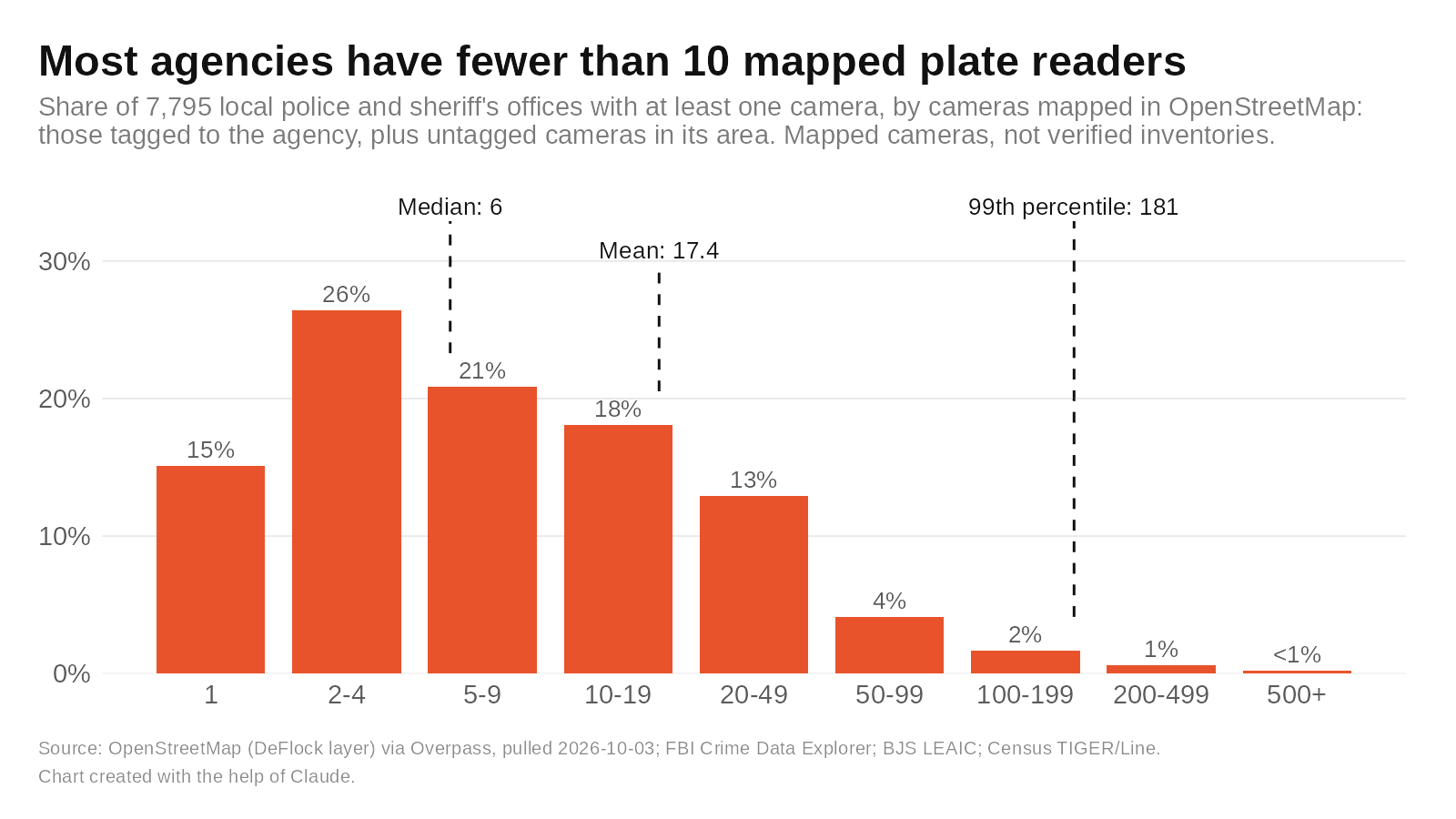
The answer? Not many. About half of all departments have no mapped cameras whatsoever. Among departments with any, the median number of cameras is 6; 90 percent have 36 or fewer.
There are a few reasons to think that these are overestimates. The DeFlock data are crowdsourced, and while they’re sometimes labeled to identify which cameras belong to private entities, there are almost certainly some being swept in here as belonging to police that aren’t. I also think, frankly, that a database created by anti-Flock advocates will tend to overstate the number of Flock cameras.
On the other hand, assigning areas to PDs is a tricky business, this is a big data set, and while I think the LLM’s decisions seem prima facie reasonable, it’s totally possible I’m missing something. Maybe there’s a design choice here that is causing me to wildly underestimate the number of cameras per PD. Furthermore, while cameras getting mis-assigned inflates estimates for some PDs, the analysis is probably also assigning private cameras to PDs that otherwise wouldn’t have any, thus putting a lot of one- or two-camera jurisdictions into the dataset, and dragging down the median.
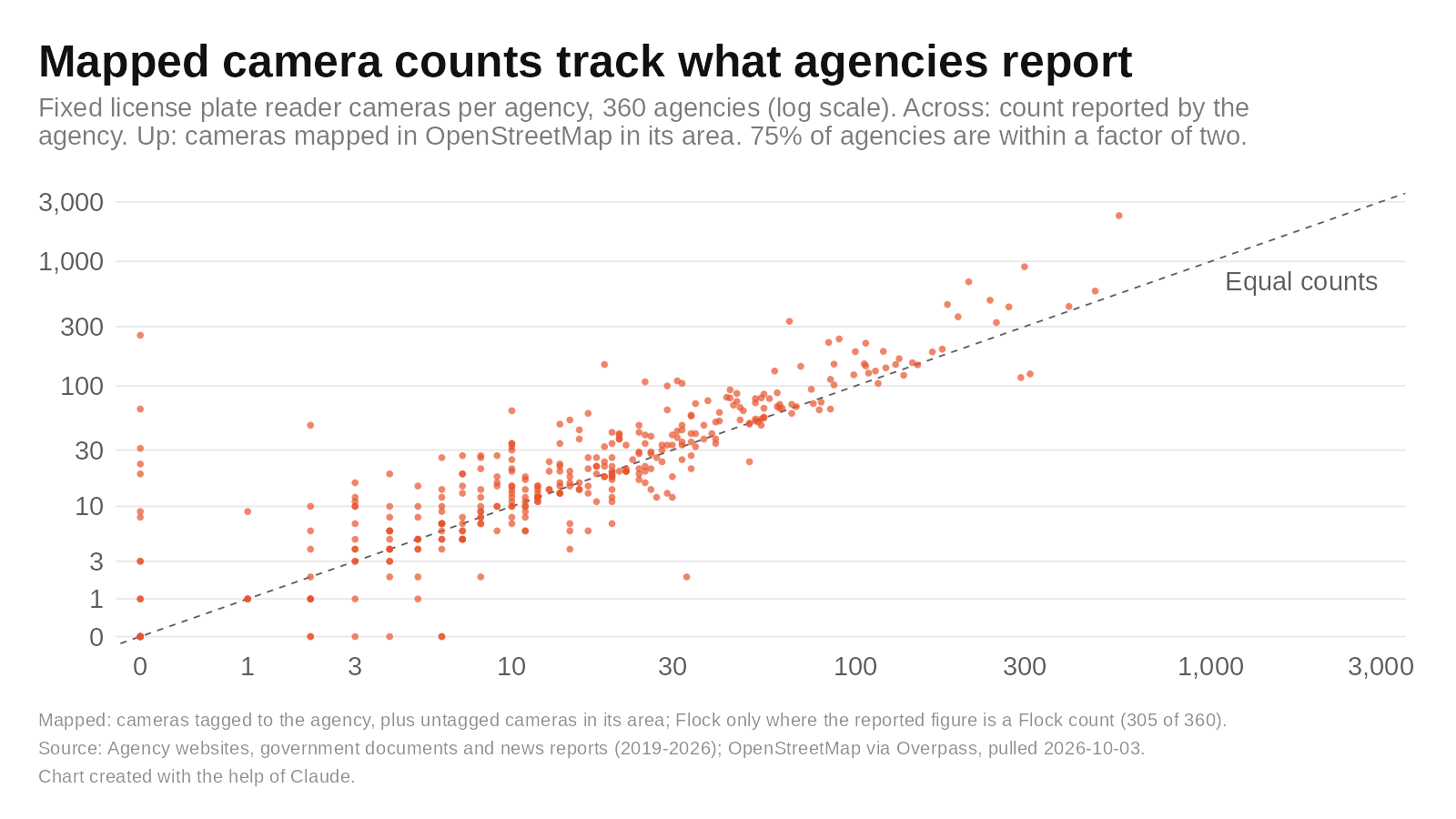
One way to test how accurate our assignment is is to compare the OSM-derived counts to a set of published counts of Flock ALPRs scraped from the internet. The chart above does that, with official camera counts for a PD on the x-axis and the DeFlock count on the y-axis.5 That chart implies that if anything, DeFlock tends to overestimate the number of ALPRs in a jurisdiction. That’s not a surprise, given its crowdsourced nature. But it should give us confidence that most PDs have relatively few cameras.
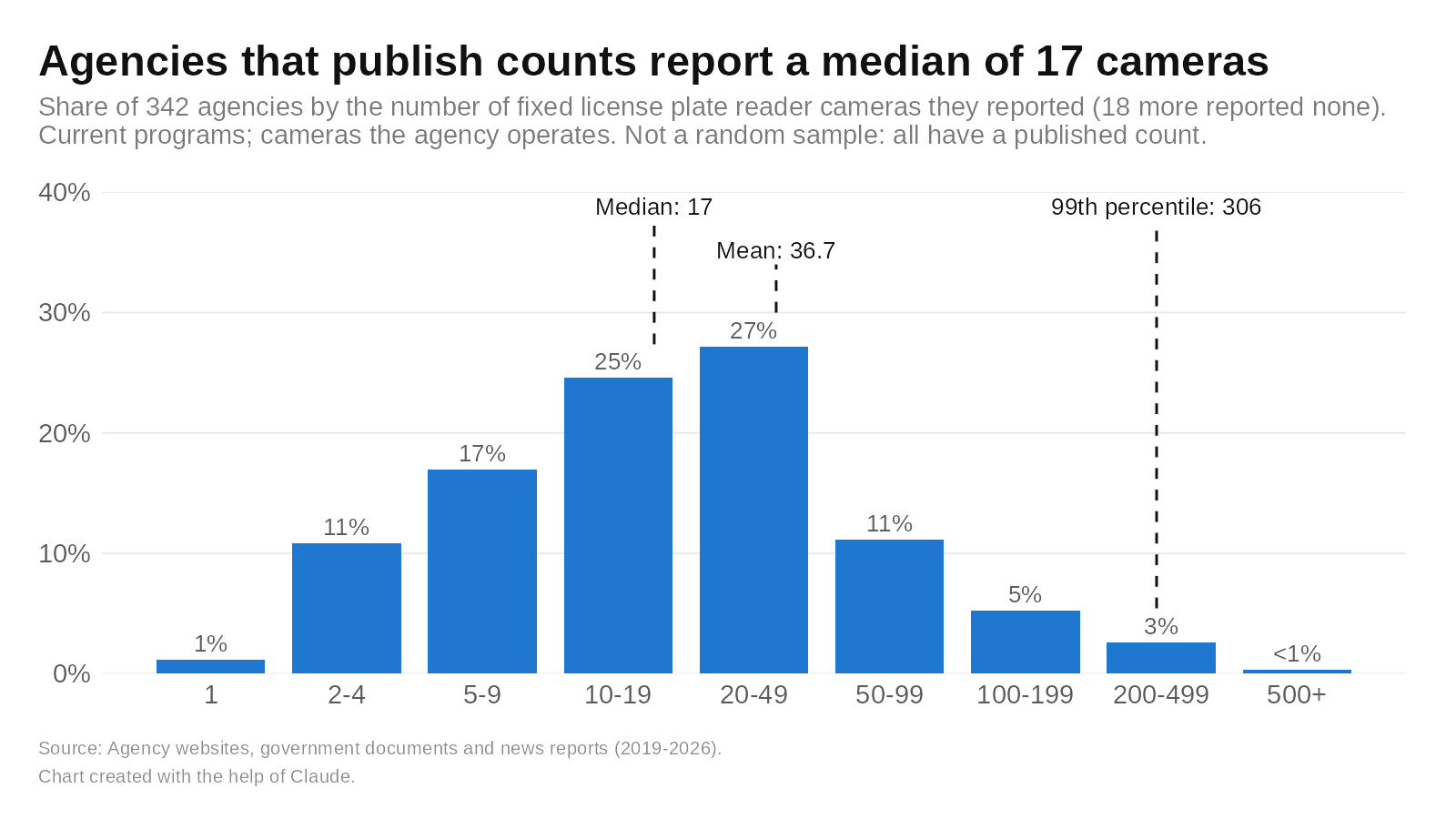
Another analysis we can do is to look at only our validation agencies and see their distribution of cameras. It’s slightly higher, but the rates are still quite low: the median PD has about 17 cameras, with a mean of ~37. 90 percent have 84 or fewer.
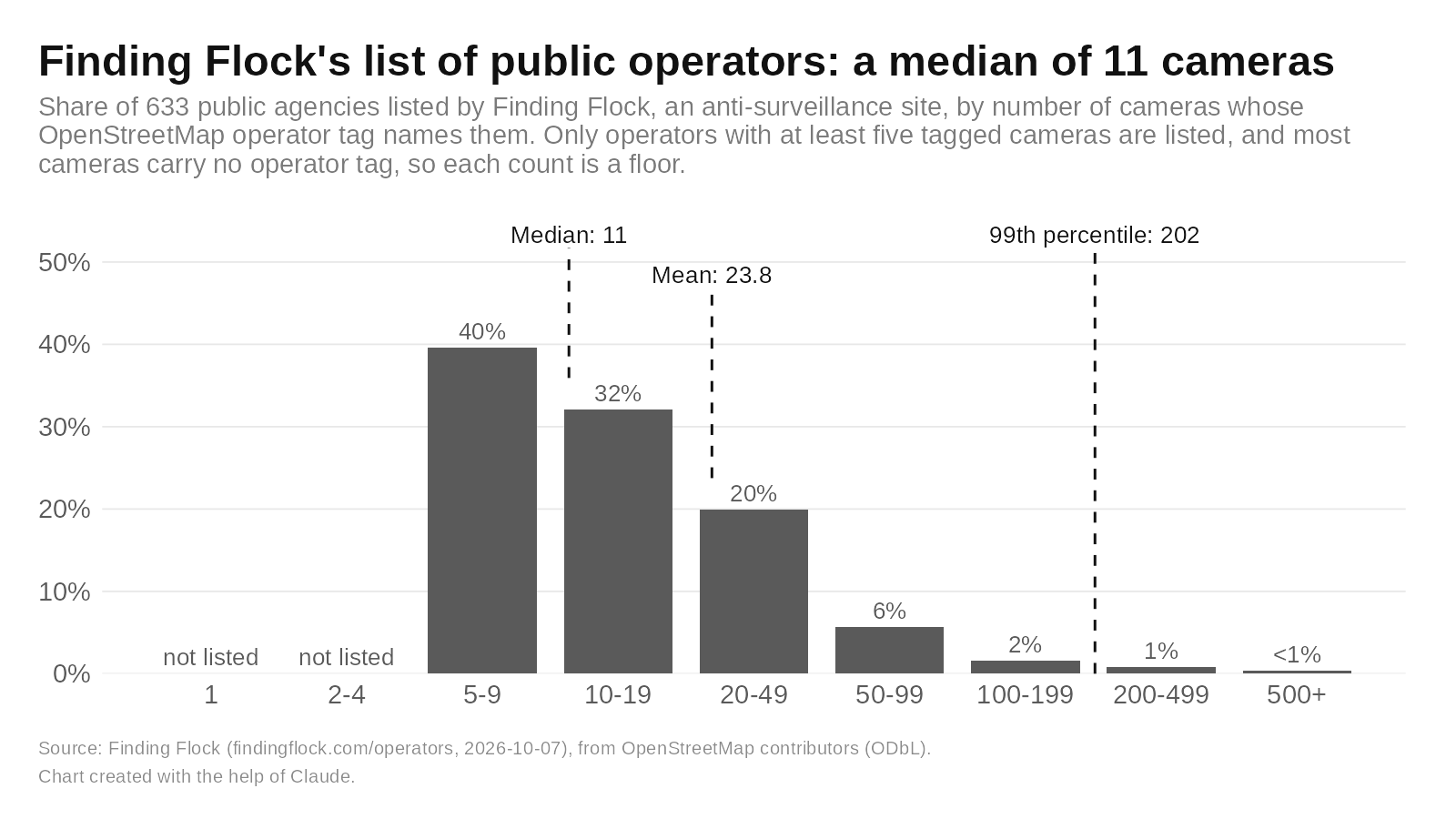
Not sold? Another source of data comes from someone else’s analysis of the DeFlock figures. FindingFlock—a pseudonymous, but seemingly Flock-skeptical6 site—publishes data on counts of cameras by a subset of operators with 5 or more cameras. Again, these are the same data source as the first graph above. But even if the first analysis is wrong, these figures come from a Flock-hostile analysis of the same underlying data, and point in the same direction.
The same general tendency shows up in other measures of Flock density. In Connecticut, the median department has 11 ALPR cameras. In Texas, the mean is 23. In North Carolina, the median is 12.
In short: the average department probably has a single-digit or low-double-digit number of Flock cameras. The vast majority have fewer than 100. 100 cameras can, of course, sound like a lot. But if you imagine our nodes and edges situation above, it amounts to relatively little visibility given any reasonable amount of surface area to cover.
All of this, it turns out, is not new information: it’s why courts have generally ruled7 that even larger networks of ALPRs do not violate the Fourth Amendment. For example, in Schmidt v. Norfolk, the Eastern District of Virginia upheld the use of an ALPR network with 176 cameras. Other cases have permitted the use of even more cameras. That’s because even very large numbers of cameras (relative to the median) just don’t produce information that’s sufficiently dense to constitute mass surveillance.
Yet another way to look at all this is simply to ask: how often do ALPR networks actually observe people in a given day? A reasonable anchor here is Carpenter, in which cell site pings gave police something like 101 “snapshots” of the defendant per day. If that’s definitely mass surveillance, we can ask: Do ALPR networks do that? Do they get close?
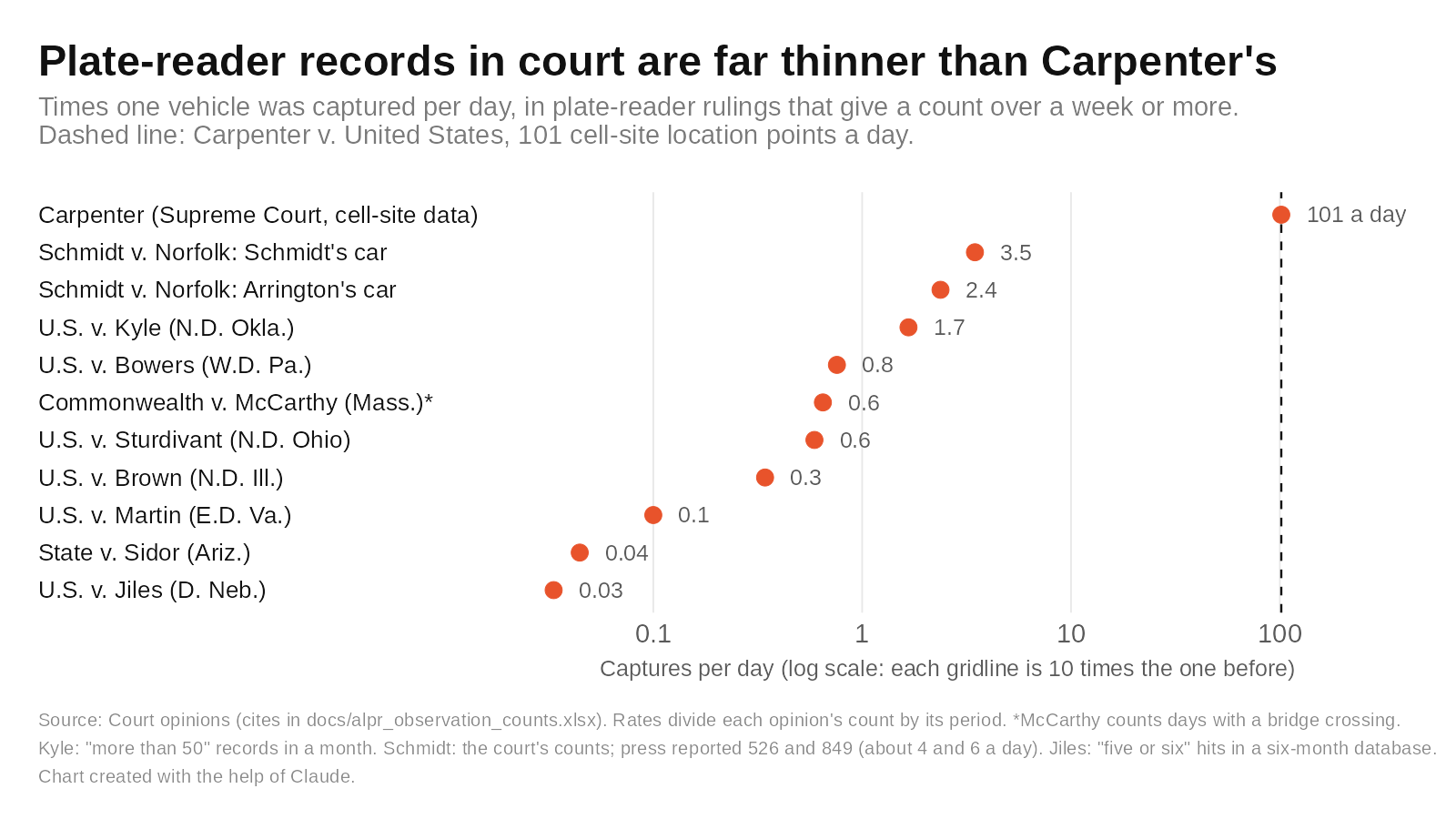
Again, in a word, no. The chart above reports data on 9 court cases that detail the number of plate reads per day (or equivalent) to which the plaintiff was subject.8 They imply that ALPRs are observing people a few times a day at most. It is very hard to do a lot of inference about the whole of someone’s movements from three data points per day, never mind a data point every three days.
One reasonable question here is: if I think ALPRs are relatively sparse, why do I think they have crime-reducing efficacy? How can I argue that they’re both a boon to cops and do relatively little surveillance? Shouldn’t those two things be correlated?
There are two answers here. One is that strategic placement of ALPRs can effectively sweep in a fair amount of crime without also sweeping in the whole of a person’s movements. In Pasadena, for example, cameras are concentrated near the Rose Bowl. That allows cops to observe crimes that occur in an area at heightened security risk without observing what everyone is doing outside of that area.
Indeed, there are almost certainly diminishing marginal returns to the crime-preventing efficacy of an ALPR. Dropping the cameras in the middle of nowhere prevents less crime than putting them down on a high-crime block. The shape of the cameras versus crime-prevented curve is plausibly not the same as the shape of the curve implied by diminishing marginal capacity to surveil—each additional camera also sweeps in fewer and fewer people. My stipulation is that because these two curves are of different shapes, most PDs have enough cameras for crime prevention purposes, but not enough to actually be running a panopticon.
Secondly, as to crime reducing efficacy, ALPRs are a tool in the policing arsenal. The presence or absence of ALPRs does not, alone, determine the crime rate. Police use them in concert with other methods of investigation. The effects of ALPRs on crime are small enough as to be totally consistent with deployments far sparser than is required for actual mass surveillance. When you add up the total contribution of ALPRs to crime reduction, it’s meaningful. But in every individual instance, it probably isn’t doing massive surveillance.
Another reasonable question is: won’t we get more and more of these cameras? Sure, PDs don’t have a lot of them right now. But what about in 10 to 20 years? Shouldn’t we regulate—or ban—proactively? To be fair, there are a handful of cities—like Houston and Atlanta—that have remarkably high densities of cameras.9 And it is the case that the cost of ALPRs keeps declining, meaning that it will become cheaper and cheaper to deploy them.
But I think it is unlikely that we’ll see blanket ALPR coverage, for several reasons. One is the diminishing returns point above—each additional camera doesn’t necessarily net you the same level of crime reduction. The second is that there’s an opportunity-cost to ALPR deployments: every one you buy is money you don’t spend elsewhere. Some PDs may talk about wanting to “blanket” the city, but when push comes to shove, they will likely want to spend limited dollars elsewhere.
Even if we do see a future in which at least some cities achieve something closer to ALPR saturation than we see today, the regulatory regime we design for ALPRs cannot be tailored exclusively to these jurisdictions. That is: some rules that make sense for a department with 20,000 ALPRs simply do not make sense for a department with 20.10 Even if future Atlanta is engaged in mass surveillance, that doesn’t mean a small town PD is. And forcing the small town PD to follow rules made for Atlanta therefore makes no sense. Forcing the small town PD to take down its cameras because you don’t like what Atlanta is doing is even less sensible.
Maybe you disagree with all this. That’s fine. Here’s my challenge: if you believe Flock’s ALPR networks constitutes mass surveillance, prove it. Provide me some quantitative metric that actually shows that it sweeps in a meaningful fraction of drivers’ movements. Do the math! I’m open to being convinced, but quoting cops and marketing material just doesn’t cut it.
I think Justices Alito, Thomas, and Gorsuch make pretty trenchant arguments here.
IJ is currently suing cities for their use of Flock in several jurisdictions, so Windham is not a disinterested party here.
Again, note here that the appeal is to what Flock et al. say in their marketing materials, not any actual estimates of coverage. Funny, that.
Epistemic status: moderately certain. The underlying mechanism here is pretty straightforward—crosswalk one map to another—but there are a lot of moving parts in the cleaning up and joining of data. There are also a lot of researcher DFs in deciding how, exactly, to assign which area to which PD. I’ve had Claude Fable review, GPT Astra review, and I’ve hand-reviewed the code to the best of my ability. Still, it’s possible there’s some glaring AI-generated error here none of us is catching.
Epistemic status: pretty certain. This is an even more simple task—scrape text and organize in a spreadsheet. And I hand-reviewed 20 or 30 of the entries, finding no errors.
and pretty obviously AI-generated,
With the exception of two lower court rulings, one of which has been overturned, and the other of which is barely a month old.
Epistemic status: quite certain. I hand-checked these myself.
Local news in Atlanta claims a typical 15-minute commute passes 30 cameras. I would love to see how they reached this number!
For example, this is one of the many reasons a warrant requirement is a silly form of regulation. Even if some systems are large enough to need it, why should a PD with five ALPRs require a warrant to look at them?
I would focus less on share of surveillance and more on getting specific court approval when using it. Something like a judge who approves any request to track or find a car.