

I went viral on X (the Everything App) last week by surfacing a remarkable fact: for the first time on record, more Americans consume1 marijuana every day than smoke cigarettes or drink alcohol every day.


Those results show up in the new data tables for the National Survey on Drug Use and Health, the federal government’s big annual drug use survey. You’ll note that, by their estimates, marijuana eclipsed alcohol a few years back. Now, the steady decline of cigarette consumption has put cigarettes behind marijuana too. As my friends over at the Foundation for Drug Policy Solutions note, marijuana use disorder is also now the second most common addiction, with about 19.3 million Americans meeting the criteria versus 25.7 million Americans with an alcohol use disorder.
Notably, while alcohol outpaces marijuana in the absolute number of people with a use disorder, the share of marijuana users with a use disorder is much higher. In 2025, 173 million Americans aged 12 and up reported drinking alcohol in the past year, implying about 15 percent have an AUD. By contrast, 61.5 million reported consuming marijuana. That means 31 percent of consumers meet the criteria for an MUD, more than double the alcohol rate.
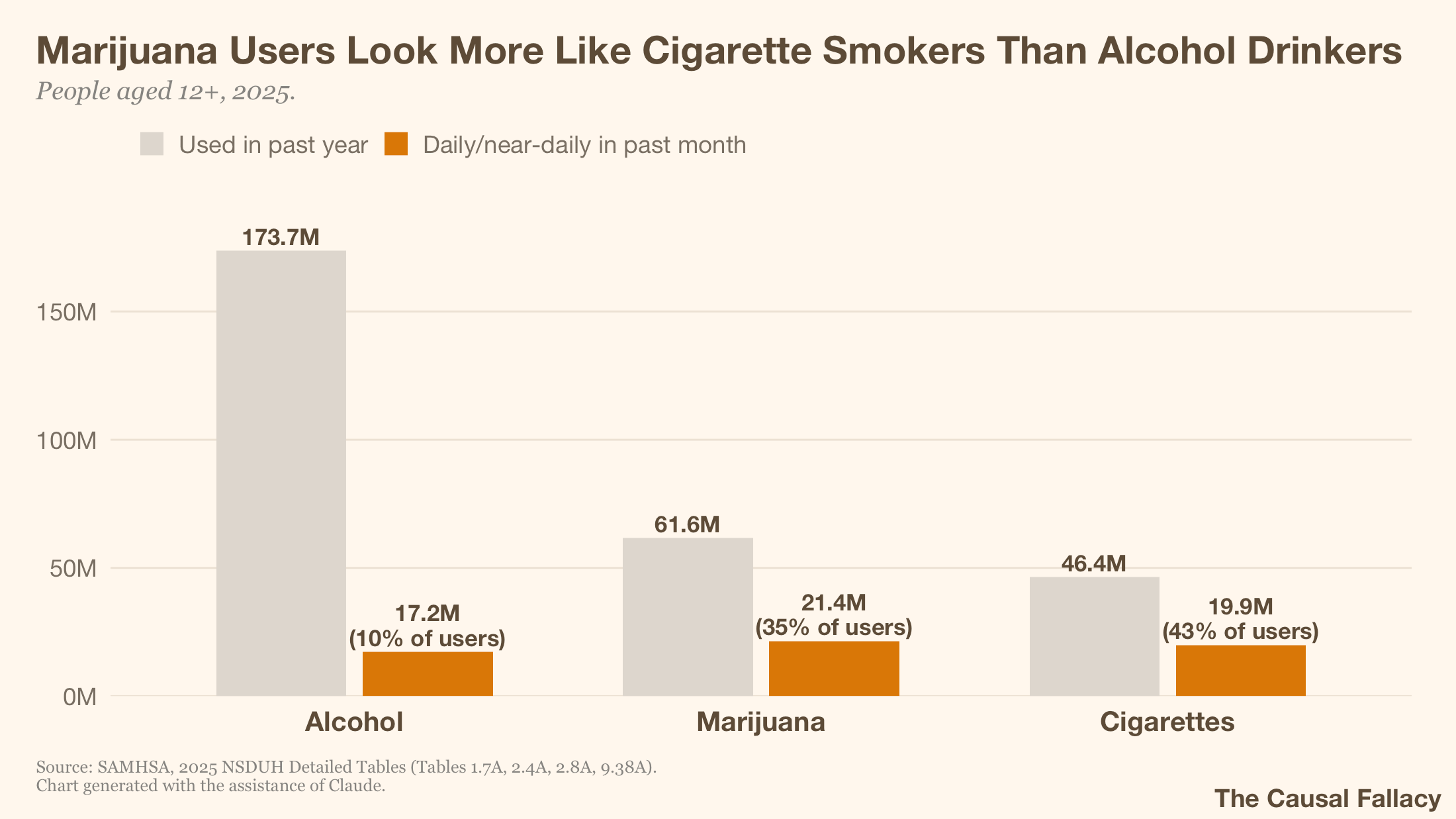
In fact, when you look at it by frequent-user share, marijuana looks a lot more like cigarettes than it does alcohol. As of 2025, daily or near-daily consumers make up about a third of marijuana users, compared to about 40 percent of cigarette smokers, but just 10 percent of alcohol drinkers. There are casual/non-daily users of all three substances. But casual use of alcohol is far more common than casual use of cigarettes or marijuana.
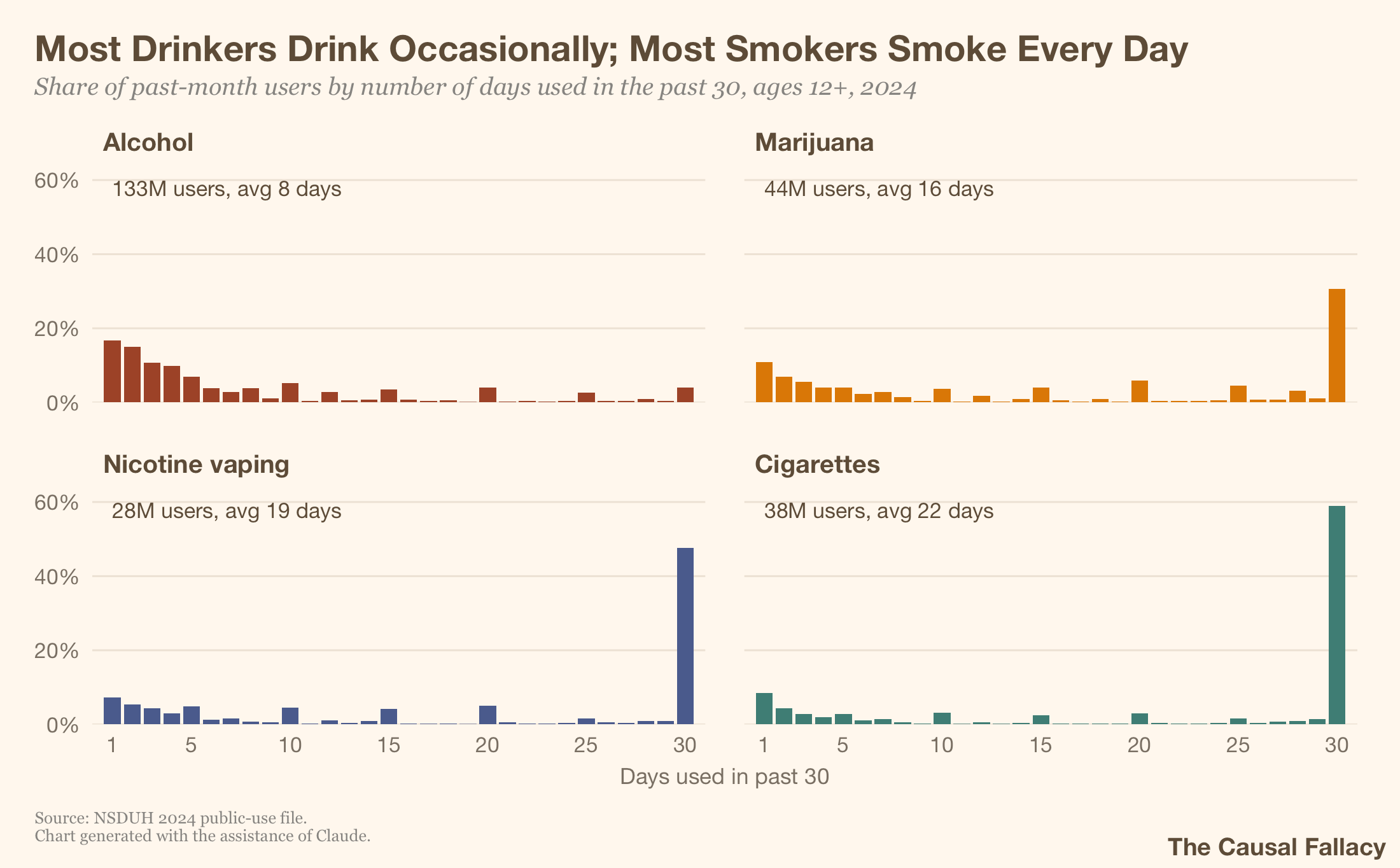
Another way to look at this is the self-reported frequency of consumption among those who used each substance in the past month. Alcohol consumption is overwhelmingly clustered at the low end of the distribution—most people drink fewer than four nights a month (the equivalent of once a week, more or less). For marijuana, by contrast, the modal user reports using every single day—a pattern that more closely resembles cigarettes and nicotine vaping.2
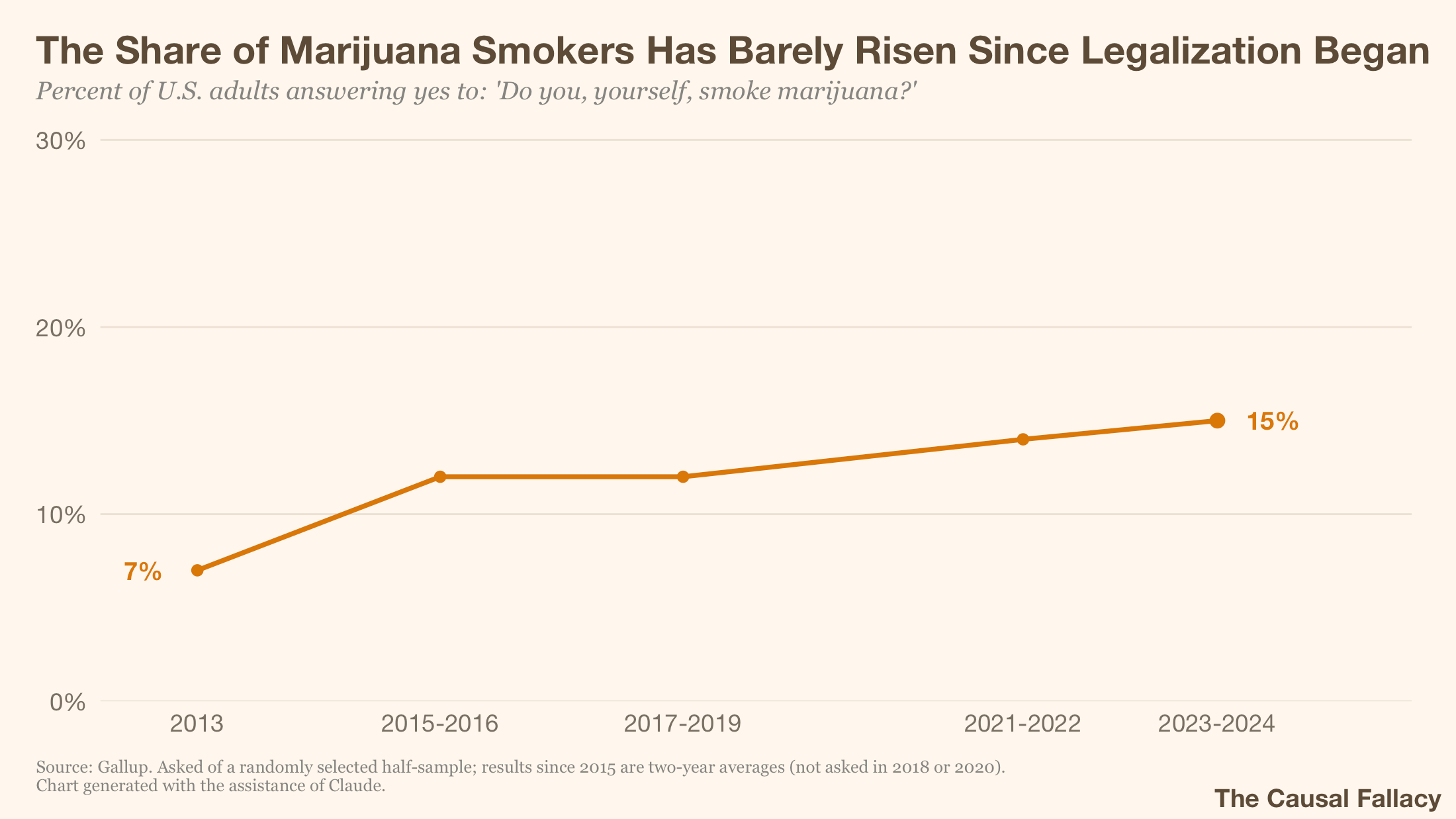
Maybe this concentration will attenuate as marijuana legalization spreads, casual consumption becomes more common, and the denominator of the daily user share grows. Maybe, but I doubt it. Per Pew, a majority of Americans now live in a state with access to recreational pot, 74 percent live in a state with either medical or recreational access, and 79 percent live in a county with at least one dispensary. And, lest we forget, marijuana was accidentally legalized nationwide in 2018. Yet over the period from the first recreational legalization in 2012 to 2024, the share of people who identify as pot smokers rose all of 8 percentage points. Daily use has risen far faster than past-year use. Maybe full nationwide legalization will change this trend, but don’t bet on it.
For a long time, alcohol has been the reference point for advocates of legalization. We tolerate alcohol just fine, is the argument, and alcohol prohibition “failed.” (It didn’t, but whatever.) Alcohol is a popular recreational intoxicant, just like marijuana. Doesn’t legalization just mean adding another product like—or, arguably, healthier than—alcohol to our culture?
But, I suspect, we are going to come to think of marijuana as analogous not to alcohol, but to cigarettes: something mostly consumed by a small number of chronically dependent users, rather than something widely consumed by infrequent, recreational consumers. And in fact, I think the marijuana–cigarettes analogy is fairly powerful both for describing marijuana’s qualities and for thinking about its trajectory.
Start with the analogy by health effects. To massively oversimplify, the primary harms of alcohol are instant to consumption. Lots of people die from the cumulative health harms of drinking, of course—about 30,000 by alcoholic liver disease, for example. But if you total up the social burden of alcohol—accidents, crimes, interpersonal conflict, etc.—I suspect that the total cost of harms done by people actively intoxicated by alcohol outweigh the total cost of harms done by chronic alcohol use.
By contrast, the vast majority of harm done by cigarettes is cumulative. One puff barely affects you. Light and intermittent smoking carries health risks, but they are far less than the risk associated with daily cigarette consumption. The massive morbidity and mortality burden generated by cigarettes concentrates among people who smoke or smoked daily.
Marijuana shares features of both of these drugs. It’s an intoxicant, and legalization contributes to things like workplace accidents and car crashes. But because it doesn’t seem to cause aggression in the same way alcohol does, marijuana intoxication probably doesn’t contribute meaningfully to crime or externalizing antisocial behavior. Rather, I suspect that over the long run the largest social burdens of legalization will come in the form of marijuana’s health harms to chronic users: heart attack, stroke, respiratory system damage, possible lung cancer, and schizophrenia.3
Marijuana is more like cigarettes than like alcohol, in other words, insofar as the costs imposed by legalization will be generated mostly by a small number of chronic users, rather than a large number of casual users. The average alcohol use session is far riskier, socially speaking, than the average cigarette or marijuana use session; I think it is likely that the harms of pot will end up being cumulative.4
A second way in which marijuana is more like cigarettes than like alcohol has to do with a puzzle many soft critics of legalization struggle with: why is pot so potent these days?
As I’ve observed previously, this isn’t really surprising. Regular users of pot use a lot more than do casual users: someone who smokes pot every day uses 30 times as often as someone who smokes once a month, for example. Regular users tend to develop tolerance, meaning they require more and more THC to get the same experience. And they tend to care a lot about THC per dollar (because they consume a lot against a fixed budget, so higher costs crowd out other consumption priorities).
As a result of all this, regular users will on average want more potent products. And because they drive consumption, an efficient, profit-motivated seller will tend to cater to the heavy consumer. The rising average level of THC therefore is the result of supply meeting demand.
When I make this argument, the retort I usually get is: what about alcohol? Some people are addicted to alcohol, yet the market is not saturated by Everclear. Instead, there are a wide variety of products of different potencies available. People who make this argument sometimes suggest that what I am blaming on liberalization is really the result of continuing prohibition. Once we legalize it nationwide, they contend, the potency problem will go away, as companies are finally able to provide the full scope of what consumers really want.5
But of course, marijuana isn’t like alcohol; it’s like cigarettes. There is not wide variation in the nicotine content of cigarettes: in general, they contain between 10 and 15 milligrams per cigarette. Casual smokers might prefer lower nicotine products, but the market does not provide them at any meaningful scale in the way that one can get, for example, low-ABV alcohol. (In fact, a major deterrent to smoking initiation is that the first few cigarettes are often quite unpleasant until users acclimate.) That’s because the market is servicing the modal smoker, who smokes daily and has developed a nicotine tolerance.6
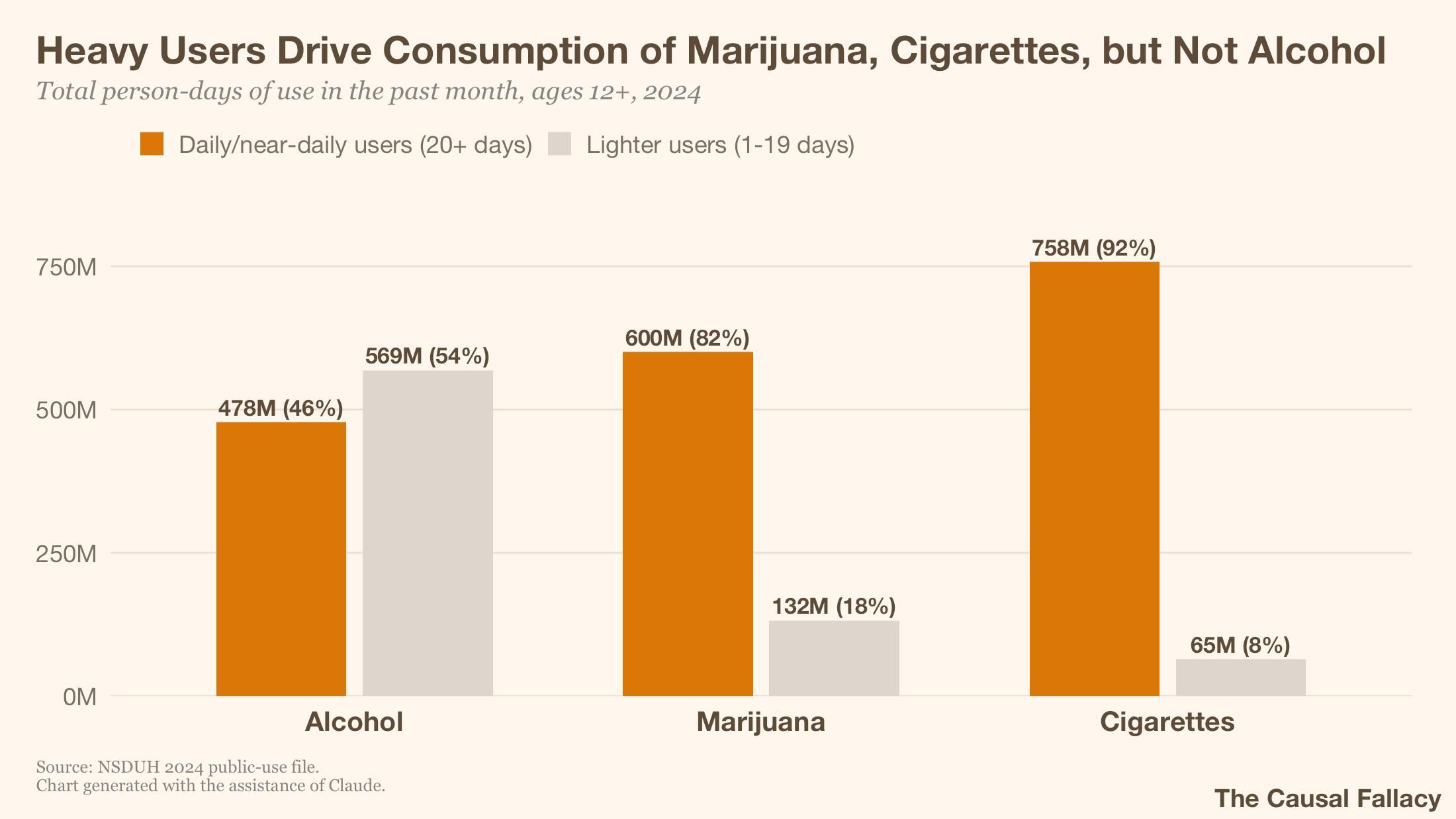
One simple way to understand this is to look at the distribution of consumption by person-days—that is, the sum of days of consumption done by daily and non-daily users in a month. Yet again, marijuana is more like cigarettes than like alcohol. For alcohol, total days of consumption is about half-and-half between regular and non-regular users. For marijuana and cigarettes, consumption is overwhelmingly driven by heavy users. Supply in each market reflects these facts.7
In this light, there is no mystery at all as to why marijuana is so potent: it’s as potent as the modal user wants it to be. No one thinks it’s odd that there isn’t a wide variety of low-nicotine cigarettes. Why should we expect a big market for low-THC marijuana? The fact that there used to be so much low-THC pot was a side effect of prohibition suppressing potency.
This brings me to the third, more speculative way in which marijuana is like cigarettes: politically.
The basic reason why we can’t (and, in my view, shouldn’t) prohibit alcohol is that almost everyone uses it. Repealing the 21st Amendment would probably reduce total harm across society, but it would also be profoundly undemocratic. Alcohol is the vice we’ve decided to live with, and that’s more or less that.
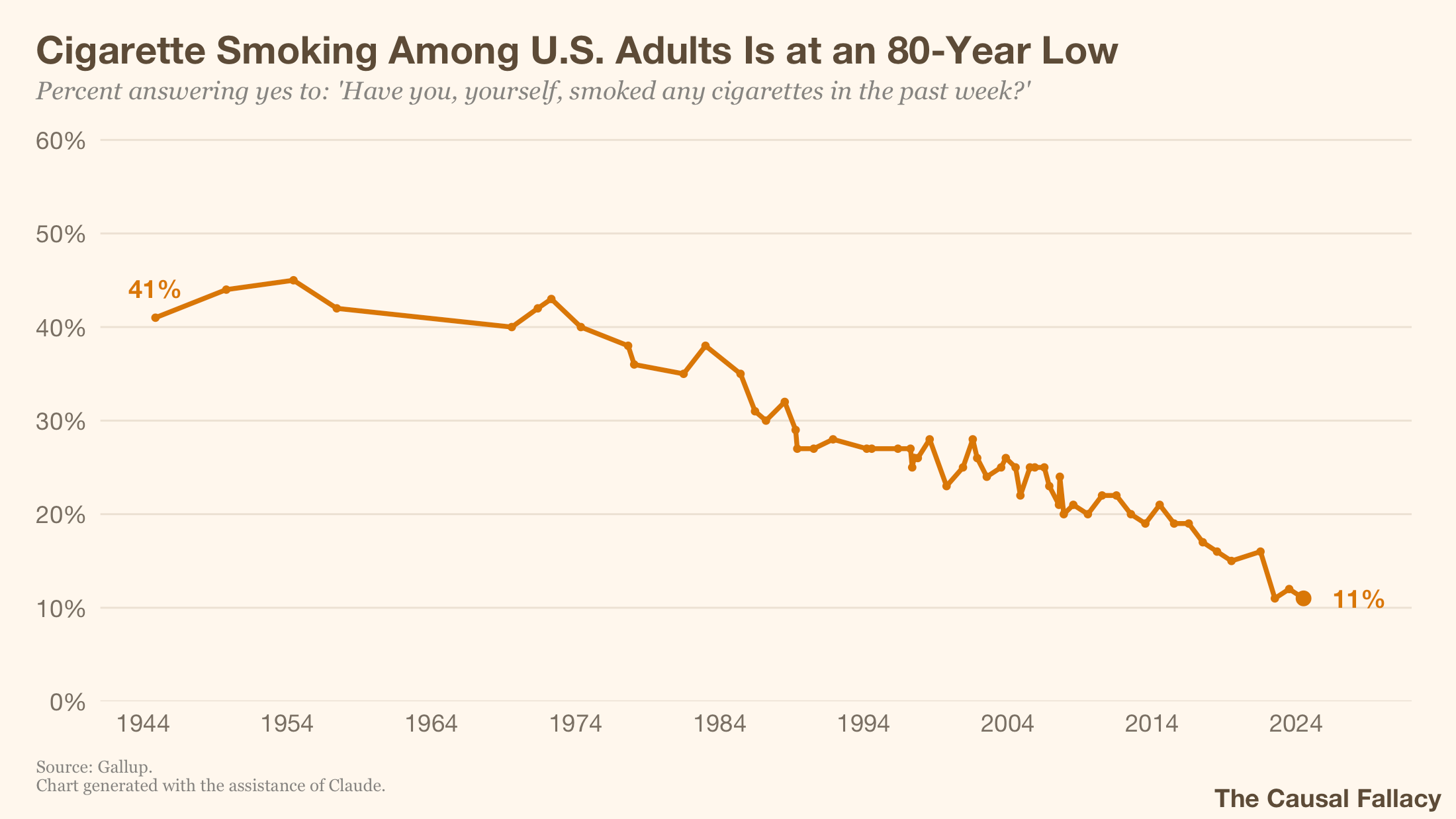
Cigarettes, interestingly, also used to be widely consumed. But a multi-decade anti-smoking public-health campaign has whittled away the smoking population through public messaging, stigmatization, and the relentless battering of the industry. Part of the reason that the modal cigarette smoker smokes daily is that many of the people who would smoke casually have been successfully deterred by this initiative, leaving only the hardcore remnant behind.8
The result of this has been a feedback loop, where as the constituency of cigarette smokers shrinks, the political possibilities for limiting access to cigarettes grows. That’s part of why the Maldives, the UK, and a number of Massachusetts towns have moved toward full prohibition through a “generational ban” that phases in by prohibiting people born after a certain year from purchasing tobacco.
This electoral dynamic, though, may be generalizable. As I wrote in The Atlantic:
At this point, the returns on public-health messaging and social stigma might be bottoming out. Does anyone still smoking Marlboros not know by now that cigarettes can kill them? But precisely because of the success of policies that stopped short of prohibition, the constituency of voters who would oppose a ban has dwindled. Indeed, a 2023 poll found that a majority of Americans would support banning all tobacco products. Legal stigmatization produced cultural judgment that, in turn, may eventually acquire the force of law. …
[Many] addictive products were initially met with enthusiasm; many are now facing backlash. In each case, the moderate position is to endorse some degree of regulation while stopping short of being so crude as to ban something harmful outright. But if the experience of tobacco is instructive, then stigmatizing, taxing, and regulating something for long enough can eventually create the conditions for an outright ban.
I think you see this dynamic at play already, to an extent. Ask people who are unhappy with legalization why, and (anecdotally) they will point to the social consequences—the shops, the smell, etc. But they will also cite the things that (they believe) marijuana does to you: makes you unmotivated, shiftless, a “loser.” Fair or not, what they are envisioning is a picture of the chronic daily marijuana user. If that’s the constituency for legalization, then legalization is going to have some troubles.
Right now, of course, there is broad support for legalization. But, as I argued previously at City Journal’s Substack (subscribe!) a lot of that support is probably soft, a messy middle of people who don’t smoke pot themselves, but feel guilty about the idea of putting someone else in prison for doing it.
It’s not clear to me, though, that this political equilibrium persists over the long run. As the public’s and elites’ views of marijuana worsen, the hard-core of daily users may find themselves at an increasing political disadvantage. Unlike alcohol, they will not have majority consumption on their side. Instead, they will be a political minority, in a democracy with a demonstrated willingness to severely curtail a minority’s access to vicious substances.
Marijuana is like cigarettes, not alcohol. Which suggests to me that marijuana might, after long enough, find itself in the same unenviable political position in which cigarettes are found today.
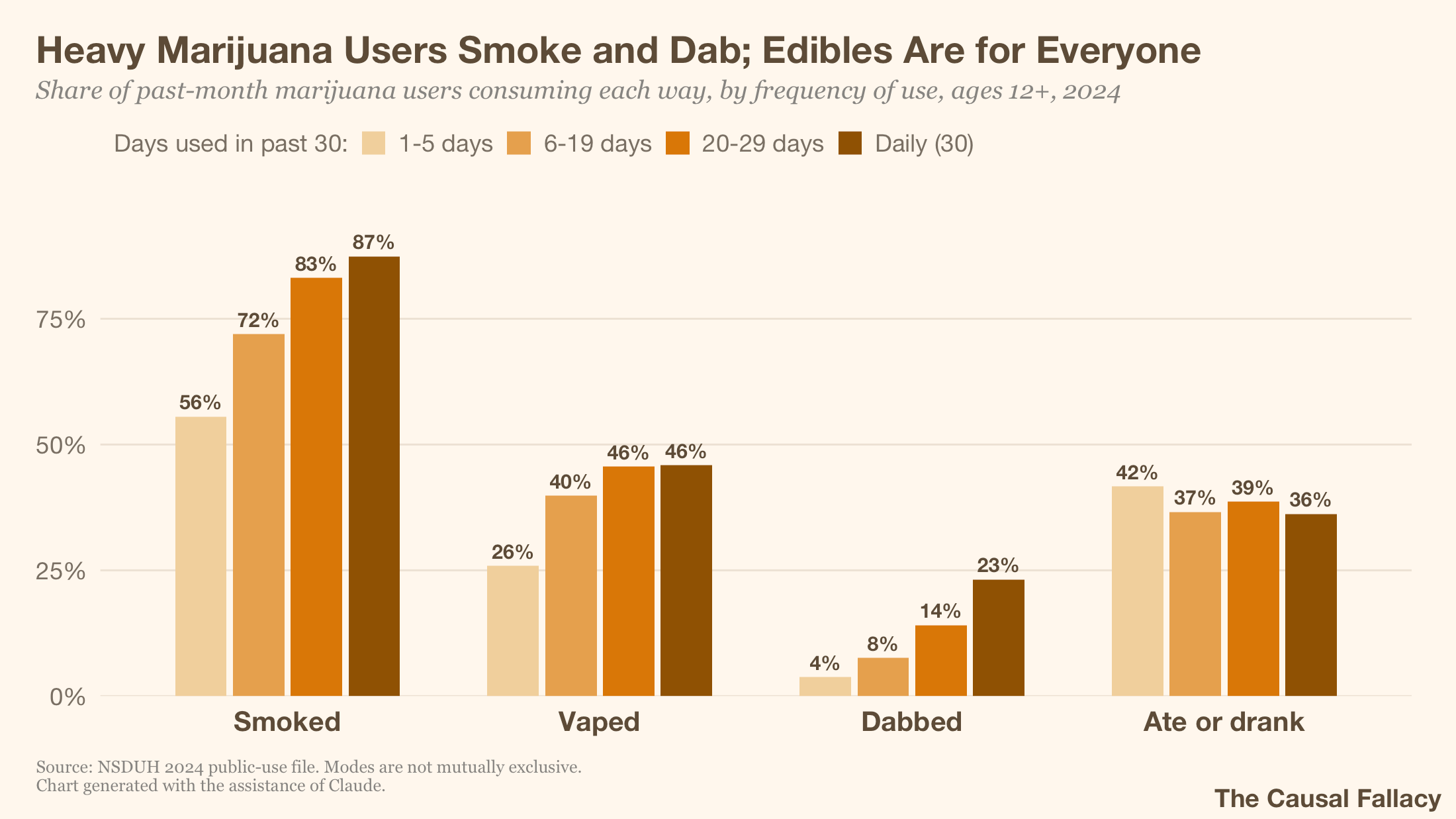
I’m going to use the word “consumed” to describe what people do to marijuana, because while the large majority smoke it, a sizable minority consume it through vaping, edibles, and other THC-infused products.
Why is vaping on this chart? Because Claude threw it in there for symmetry’s sake and I decided to keep it.
Marijuana and cigarettes also share one big, obvious externality: they both smell bad.
This is sort of speculative, and if someone wants to do some math and prove me wrong, I’m not wedded to this argument. But I think it’s sort of necessarily true given the distributions of consumption discussed above. Just as a matter of math, way more people do something dumb while drunk once per month than drink themselves to death every night! Conversely, if most marijuana and cigarette users are daily/near-daily, and if neither drug has a lot of per-use-session harms, then most of the harms should concentrate among that pop.
This argument makes no sense for a number of reasons, but that’s a discussion for a different time.
One argument against this position is that people vary their desired level of nicotine intake by the number of cigarettes they consume. And that’s true, but there’s no reason for that not to be true for marijuana (you can smoke, vape, or otherwise dose as much as you want). But this is orthogonal to my point, which is that there’s relatively little variation in the potency of cigarettes, unlike the variation in the potency of alcohol. And that’s because of the consumers.
The variation in how people use is also notable here:
Long-time readers will recall that this was basically what the War on Drugs did too.
Factors you might not have considered. Marijuana use puts a gun owner/buyer in the same category with Hunter Biden, you have committed a felony by admitting to it- so you're not going to admit to it. Not to anyone, under any circumstances- unless you're an "scofflaw". Another factor is marijuana use by children, especially the high-powered stuff common today. I'm 78, I smoked my first pot in college. I enjoyed the effect but I didn't like the interference with memory- so I never became a regular user. They used to say "If you can remember the 1960s, you weren't there." Once a year, maybe- and I remember the 1960s. If I was passed a joint in an appropriate social circumstance, I might toke on it- but it was never a regular part of my life. Soon after marijuana use became ubiquitous in high schools. Vaping made it undetectable. At the same time we had the "great dumbing down" of education, especially in math. I have to believe those two things are related. You can't smoke pot and do math at the same time. I also blame it on "The Great Feminization" (google it) because women love drugs. All drugs, especially opioids and marijuana. Give a woman power (as a teacher, especially) and you have a "self-driving school bus", the inmates running the asylum. If you have impaired memory, how can you learn? IQ of college grads have gone from 120 to 103 in the same time period. Few college grads (mostly women, today) know what the Pythagorean Theorem is, let alone how to use it. Keep up the good work!
duh of course you’re right, cigarettes = cool, weed = cool, alcohol = lame, did you even show them the math?