


If you advocate, as I occasionally do, for the prohibition of certain harmful, habit-forming products, someone will inevitably raise the specter of black markets. Here, simply to offer one illustrative example, is a reply to my saying we can just ban gambling from Morning Brew’s Phil Andrews/Maxinomics:

Andrews’s claim is a typical one: if you ban a product, it will simply “shift” into the unregulated/illegal marketplace. As he put it to me later on, “you want to ban it so usage can fall 30% but the other 70% can accrue to organized crime?”
I don’t mean to pick on a handful of tweets. But this is an argument one hears all the time—so often, in fact, that I am writing this post as a comprehensive response to what I have come to think of as the “black markets fallacy.”
It is not fallacious, of course, to say, that prohibitions creates black markets. They do. What’s fallacious is to argue that this fact necessarily means the prohibition does not “work,” or is not better than legalization. Put simply, the black markets fallacy says: “the fact that prohibition creates black markets is a sufficient justification for not prohibiting, because the harms of the black market always outweigh the harms of the legal market.”
When you unpack it, people who raise the topic of black markets are usually making at least one of four claims:
The quantity consumed under prohibition is always the same as the quantity consumed under legalization;
The harms associated with a prohibited harmful product are always greater under prohibition than under legalization;
The crime costs of prohibition are always quite large;
The enforcement costs of prohibition are always quite large.
It is not that these four claims are never true. But they are quite often false. Quantity consumed under prohibition is almost always smaller than quantity consumed under legalization. Prohibited products can be more harmful than their legal equivalent, but legal products can also be, and often are, more harmful than prohibited equivalents. The crime costs of prohibition vary widely, and are amenable to enforcement. Conversely, the enforcement costs of prohibition vary widely; the two variables (crime and enforcement) can be optimized relatively easily.
I’ll demonstrate that each of these four claims is true below. Because they’re true, the black markets fallacy has to be false: the mere fact of black markets is not an adequate justification for legalizing a product. Rather, advocates of legalization need to show why in their specific case, legalization is preferable to prohibitions—not just assume it.
“The quantity consumed under prohibition is always the same as the quantity consumed under legalization.”
I touched on this a while back in my reply to Freddie DeBoer. The basic idea is that people have a constant want for drugs, or gambling, or porn. If you make them illegal, the same people will get the same products from the black market, which will spring up to meet exactly the same demand. More formally, demand is often assumed to be highly or perfectly inelastic: whatever effect prohibition has on supply, people keep buying the same amount. The only difference between the markets is that the black market is less safe (more on which in a moment), not the amount of the prohibited product actually consumed.
This is a fairly common assumption, but it is both theoretically incoherent and empirically usually false. Legalization and prohibition of addictive products have large effects on quantity consumed. That’s because prohibition reduces supply, and because demand for these products is actually not highly or perfectly inelastic, especially not in the long run.
Empirically:
Recreational marijuana legalization (i.e. commercialization) increases adult past-year use by 25 percent.
Legalization of sports gambling causes gambling spend to rise roughly four-fold.
The estimated size of the total market for sports gambling—legal and illegal—is about 50 percent larger than it was before legalization began.
During Constitutional prohibition, alcohol consumption initially fell to 30 percent of its pre-prohibition level, then rose to 60-70 percent. It remained significantly lower following prohibition than it was before.
The one-time legal sale of previously prohibited ivory to China and Japan in 2008 led to a 66 percent increase in illegal ivory production and a 71 percent increase in its smuggling.
The unintentional decriminalization of indoor prostitution in Rhode Island increased the quantity of sex sold as measured by advertising and reviews, including a 135 percent increase in the latter.
Merely age-gating access to porn—not even banning it outright—reduces consumption by about 10 percent.1
Legal availability of fireworks is generally associated with greater rates of firework-related injury, indicating greater use.
Legal access to “raw” milk is generally associated with greater rates of food-borne illness, indicating greater use.
It is not absolutely always the case that prohibition has large effects on quantity consumed. Where the prohibition is easy to evade—as, for example, in the Indian state of Bihar’s prohibition on alcohol—effects can be small. And if there’s a readily available substitute—as with e-cigs versus cigarettes—people will switch. But in general, a prohibition on a harmful product will tend to reduce the quantity of that product consumed, while legalization will tend to increase the quantity consumed, both often by quite large relative amounts.
The basic reason for this is straightforward. As I’ve explained over and over again: prohibition is a form of regulation. It reduces the supply of the prohibited product, which yields less quantity consumed in the equilibrium. Prohibiting a product imposes costs on the industry that produces it: they lose access to financial capital, skilled labor, and materials from third parties that do not want to transact with a prohibited business. That makes the remaining industry much less efficient, in turn causing it to produce less at a higher cost.
Of course, this won’t matter if the demand for the prohibited good is highly or perfectly inelastic. If it is, then consumers will (essentially) keep buying the same quantity at whatever price. This is often assumed to be the case with addictive products—people who are addicted to them need them, so therefore they will pay whatever they have to to get them.
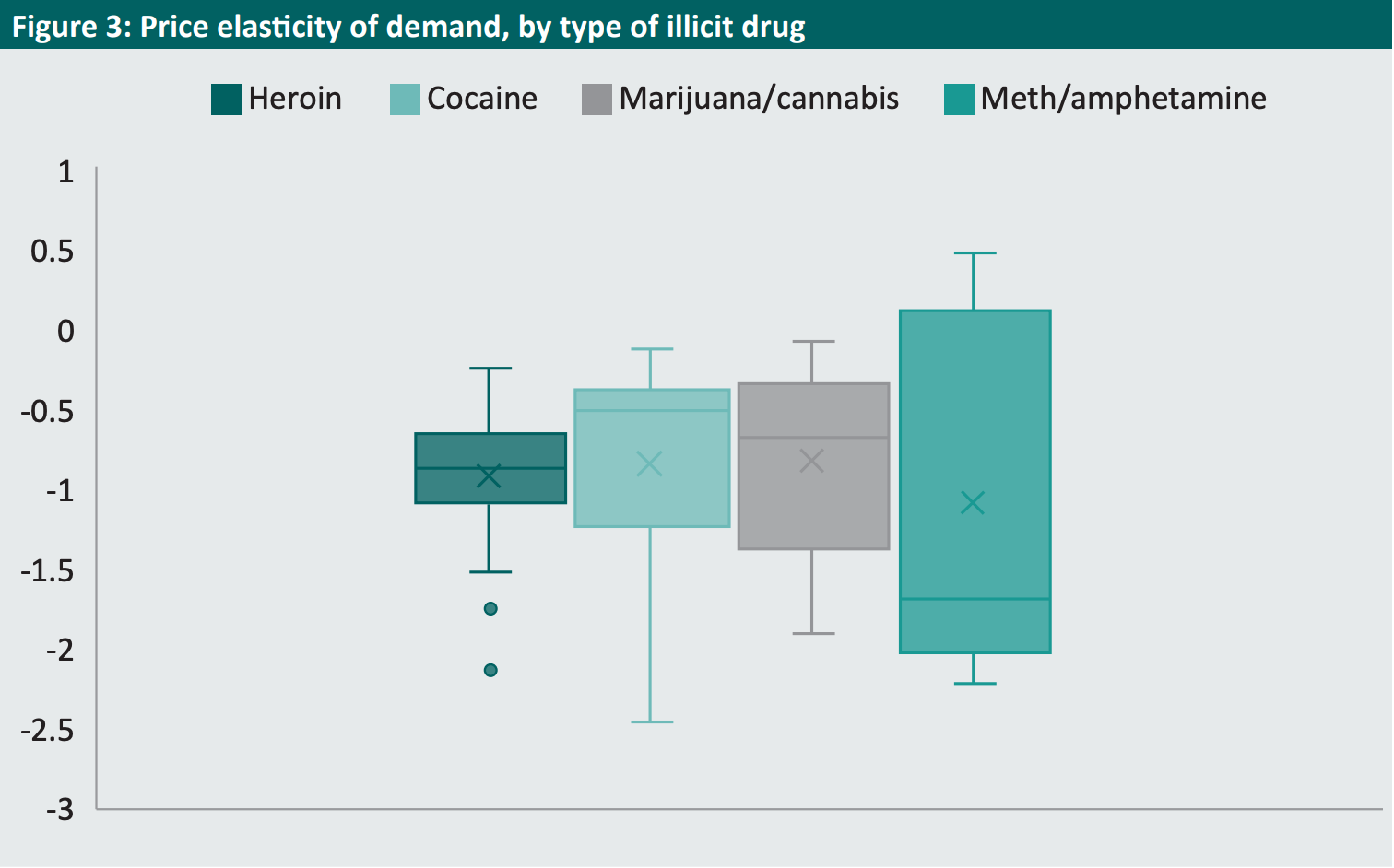
The empirical reality is more complicated. Demand for drugs is close to unit elastic (“a 10 percent increase in the price of illicit drugs results in a decrease in demand of approximately nine percent”), with some variation: that meta-analysis finds an average elasticity of -0.94 for heroin, -0.84 for cocaine, -0.79 for marijuana, and -1.08 for amphetamines. Gambling elasticities vary by type of gambling, but by one meta-analytic estimate, horse racing and lottery are basically unit elastic, while casino gambling is only moderate inelastic (-0.7). In short: the elasticity of demand for these addictive products looks nothing like what the black markets fallacy says they should.
There is, of course, an important nuance here: demand is almost certainly much more inelastic for people in active addiction. It’s really hard, as I’ve argued here and elsewhere, to enforce and prohibit your way out of people actively addicted to drugs. But the long-run elasticity of demand for these products is much more elastic than the short-run, reflecting the fact that people move into and out of addiction over time. It is likely, therefore, that prohibition reduces quantity consumed and problematic quantity consumed by deterring initiated addiction in the first place.
In short: prohibition means less quantity consumed, legalization means more. That’s empirically true and makes sense given what we know about the economics. There are certain edge cases where this fails, but if you want to play the black markets card, you must show why those situations obtain; the default assumption should be that prohibition reduces quantity consumed.
“The harms associated with a prohibited harmful product are always greater under prohibition than under legalization.”
This argument comes in two forms. One is that the harmful effects of the product itself get more intense, usually because prohibition allegedly increases potency. This is our old friend, the Iron Law of Prohibition: prohibition makes products more potent, because a more potent product gives greater returns per unit risk. The other is that prohibition makes products more harmful because prohibited products are unregulated—you don’t know what you’re getting, whereas under legalization, you could get regulated, tested etc. products.
Unsurprisingly, I think neither of these is reliably true, but they require separate treatment to understand why.
Start with the idea that prohibition increases the intrinsic harms of a product. In the case of the kinds of product I’m interested in, that means that prohibition makes the product more potent: illegal weed is stronger than legal weed, illegal fentanyl is stronger than legal fentanyl, illegal gambling is more addictive than legal gambling, etc. etc. The reason given for this is usually some variation on the aforementioned Iron Law of Prohibition: “the more intense the law enforcement, the more potent the drugs will become.”
As I’ve explained previously, there’s a narrow sense in which this is true, an application of the Alchian-Allen theorem. As I wrote:
if you have two goods that are substitutes, one of lower quality and one of higher quality, then an equal increase in the fixed cost of both will cause consumers to substitute to the higher-quality product on the margin, because the ratio of the prices of the high-quality product to the low-quality product decreases. In the case of the Iron Law, enforcement imposes some fixed cost on both high- and low-potency substitutes; increasing the intensity of enforcement lowers the relative cost of the higher potency product.
But just because prohibition can have that effect does not mean that that effect dominates the way in which the prohibition-versus-legalization variable affects harmfulness. Contrast, for example, street-grade fentanyl/cocaine/methamphetamine with medical-grade fentanyl/cocaine/methamphetamine. They are chemically equivalent, but the latter is much purer (and therefore more potent per unit dose). Clearly a legal production process (the pharmaceutical supply chain) reliably produces a stronger product than an illegal production process, notwithstanding Alchian-Allen.

There’s another dimension that matters here: the legal market is more innovative than the prohibited market. This is what I’ve termed the Iron Law of Liberalization: “the more liberal the drug laws, the more potent the drugs will become.” Legal markets have the talent, capital, and technological capacity that prohibited markets often lack; this allows them to make better (and therefore more potent/more harmful) products more easily. There’s a reason, as I never tire of of reminding people, that it took 50 years for the illegal supply chain to catch up with the pharmaceutical supply chain in distributing fentanyl—it’s because the illegal supply chain is much worse at innovation. And indeed, marijuana and gambling have, as I argue in that piece, become substantially more potent under legalization than they were under prohibition, because the legal companies now selling them are way more innovative than the illegal ones that used to. We should expect this effect to dominate over the long run, in much the same way that innovation dominates most trends over the long run.
Okay, but what about the second harm-based argument—that an unregulated illegal market produces unsafe, unregulated products? Certainly, there are ways in which this could be true. Ensuring that drugs are of known potency and dose, free from toxins and adulterants, seems like hypothetically something a legalized and regulated regime ought to be able to do! Similarly, they can ensure best practices in the porn or gambling industries, to mitigate risks to users.
There are a couple of reasons we should not take this argument for granted, though. The first is that it’s not obvious that incidental harms of this sort are more important than intrinsic harms from the potency of drugs. That is to say: even if legalization makes it less likely that you get something in your drugs you don’t want, it may still be the case that the added harms that come with additional potency outweigh that benefit. I think this is likely to be true, given that alcohol and tobacco are both legal, regulated, and kill more people every year than do all illicit drugs combined. Again, to the extent that rising potency is enabled by market innovation, we should expect that term to dominate over the long run.
Secondly, it’s not obvious that regulation of this sort has much of an effect on what people consume. As I’ve explained at length in the marijuana context, in a legal market the difference between regulated and unregulated products is basically that the regulated stuff costs more. Regulated marijuana, for example, is the same plant as the stuff you can get in an unlicensed store in new York State. The only difference is that it complies with regulations, regulations which impose additional costs that get passed on to the consumer. This, in turn, shifts users to the grey market—which is why, as of 2022, 75 percent of marijuana was still being sold outside the legal marketplace. In other words, regulation can inadvertently push price-sensitive users—which includes those who use most heavily—to select unregulated product, blunting the effect of regulation.
We actually have some useful empirics on this topic as well. In 2020, the Canadian province of British Columbia implemented a policy called “safer supply,” under which it handed out hydromorphone (Dilaudid) tablets to people known to be regular drug users as a “safer” alternative to street fentanyl. In theory, this cuts to the core of the regulatory concern: the government literally handed out a checked, unadulterated product.
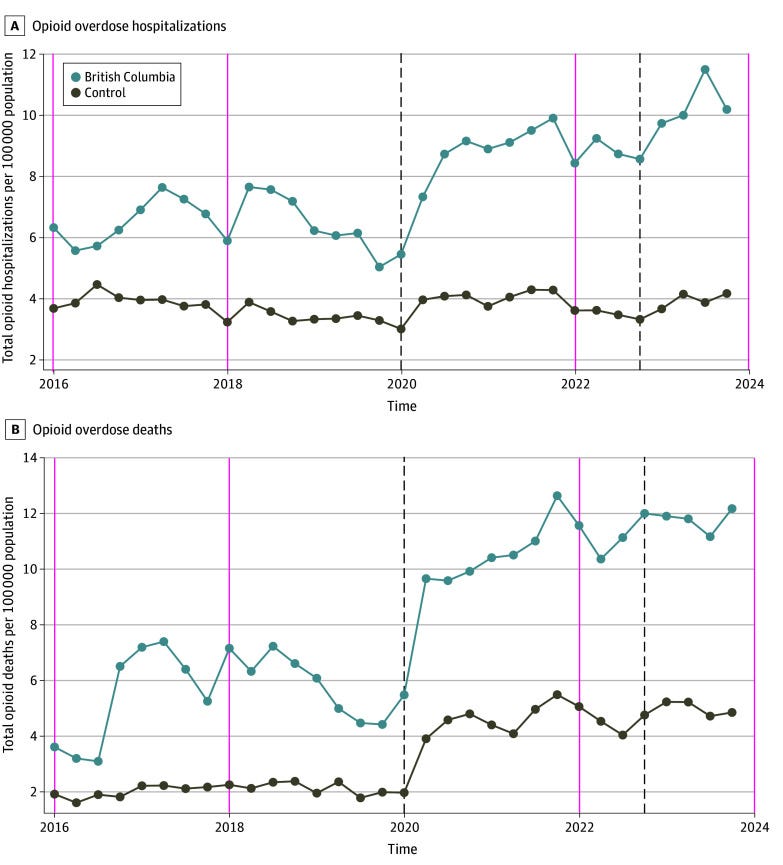
What happened? Per Nguyen et al. 2025: “The safer supply policy alone was associated with an increase of 1.66 opioid hospitalizations per 100 000 population (95% CI, 0.41-2.92; P = .009) or 33% … There was insufficient evidence to conclusively attribute an increase in opioid overdose deaths to these policy changes.”
So safer supply possibly increased overdose deaths in the Province. Maybe that’s a fluke, but it seems to me very hard to argue that a legal, regulated, unadulterated supply could be expected to be less harmful than an illegal supply. At the very least, we can’t assume that that’s what happens; we’d have to provide evidence for it.
“The crime costs of prohibition are always quite large.”
One of the reason people don’t like the “p word” is that they associate it with crime and violence. Prohibited markets are always taken to be run by violent, dangerous thugs, who cause far greater suffering than the prohibited product ever will.
This argument is, in my view, stronger than the first two. By definition, prohibited markets are run by criminals, and criminals are not, on average, great guys. Under certain conditions, it’s clearly possible for these markets to become quite problematic. Highly competitive prohibited markets can become quite violent, as sellers compete for turf and resolve disputes outside the courts (this is what happened in the crack wars of the 1980s). And organized crime can and does cause harms of its own.
Still, theory and empirical evidence tells us that violent, crime-ridden black markets are by no means guaranteed. And effective policy can and does control associated crime pretty effectively. It’s possible to minimize this cost, in other words, without legalizing drugs.
Consider some of the prohibitions I mentioned earlier, for example. Unpasteurized milk has been and today remains illegal to sell in some states. Yet there is no meaningful violence associated with the raw milk market. Nor is the market for fireworks, banned to varying degrees in many states, particularly violent.
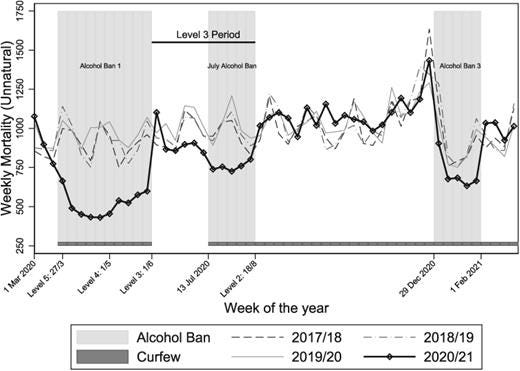
Maybe these examples are unfair—maybe just prohibited markets in addictive products are prone to serious crime? Sometimes, but the relationship is not simple. Take alcohol prohibition, usually assumed to cause serious crime. In reality, evidence suggests that state-level alcohol prohibition reduced homicide in the pre-Constitutional prohibition era. More recently, evidence from prohibitions in both India and South Africa shows reductions not increases in violence under prohibition.
Of course, alcohol causes violence in and of itself. What about pot? Don’t the markets in it cause lots of crime? State-level legalization has allowed us to test this, and the answer is that it doesn’t have much effect on crime either way. As a recent RAND corporation review of the literature explained, “[e]vidence on the effects of legalization on non-cannabis crime is more limited and generally shows null effects. Several studies examined violent crime and property crime outcomes and did not find statistically significant effects of legalization. The limited evidence does not support claims that legalization either substantially increases or decreases criminal activity other than cannabis possession.”
Even open-air drug markets are not necessarily violent. As I noted in my reporting on Kensington, Philadelphia’s drug market:
Measured generously, the market is geographically a bit less than a mile square, equivalent to roughly half a percent of the city’s total area. But that square mile was home to more than a third of Philadelphia’s reported drug-law violations in 2023. It was also the site of a quarter of 311 calls requesting help from the city’s opioid response unit, as well as one in seven calls for camp cleanups and one in seven DUIs (which include driving under the influence of drugs).
Notably, other issues are not nearly as concentrated in the area. Kensington saw 17 homicides last year, representing about 6 percent of the city’s total—a disproportionate share of the whole, but not nearly so concentrated as drug use. Other crimes, major and minor, follow a similar pattern: they’re more common in Kensington, but not nearly as common as drug-related offending. Kensington accounted for more than a thousand 311 maintenance complaints, for example—a large number, but only about 3 percent of the city total.
Maybe it’s worth taking a step back and asking: why, exactly, do we expect prohibited markets to be violent or abusive? After all, the people who transact in prohibited products do not like being hurt or stolen from any more than the people who don’t. They don’t have access to the state as a means for dispute resolution but, as the libertarians are usually quick to acknowledge, peaceful, non-state dispute resolution systems are often the naturally emergent result of markets in which people need to cooperate.
Which is not to say that you can’t have massive violence associated with the drug trade. You clearly do as, for example, during the height of the crack epidemic in the 1980s. My only point is that that that represents a distinct failure mode, in which specific actors decide to use violence as their means for dispute resolution. It is by no means a guaranteed outcome, in other words, that prohibited markets are unusually prone to serious crime. It is a possible bad equilibrium that has to be guarded against.
And policy, moreover, can specifically focus on guarding against it! Policing strategies that focus on differentially deterring violence and rolling up drug gangs have been shown to significantly reduce drug-trade associated crime. If the police focus on the non-drug violence and crime, it creates an incentive for the market to operate peacefully—which it’s capable of doing. In other words, policymakers can set their priorities with an eye toward minimizing serious crime without needing to legalize.
“The enforcement costs of prohibition are always quite large.”
That brings us, of course, to the other side of the equation, enforcement costs. Enforcing against a prohibited product is not free: it entails costs both in terms of government time and resources (for cops, judges, prison cells, etc.) and in harms to those affected by the criminal justice system (both in liberty and in long-term consequences of incarceration). If prohibition is too aggressively enforced, then these costs can exceed the benefits associated with the the added marginal unit of enforcement—a situation that, for example, I tend to think obtained in the War on Drugs.
This raises the simple question of whether and when prohibition is worth the effort. Perhaps drugs or other products are harmful, but if it costs more to control them than the gain we get from controlling them, then enforcement may not be the optimal solution. the “drug war” has allegedly cost $1 trillion since 1971.2 Are we getting our money’s worth?
Bracketing the particulars of the “War on Drugs,” it is the case that you can have prohibition enforcement regimes where the costs exceed the benefits. But this is by no means guaranteed, and—much as with crime—it is possible to optimize your enforcement regime to maximize returns.
To start, we should recognize that there are enforcement costs in both prohibited and legal markets. The long-standing dream of replacing prohibition with a “tax and regulate” model is built in no small part on the idea that while enforcement is pure cost, taxes generate some returns. This is true, but the size of those returns are bounded by the grey market—that is, the market in unlicensed and untaxed versions of otherwise legal products. Because grey market and white market products are equivalent except in terms of regulation, the higher the tax rate, the more substitution to the grey market happens. You see this not only in the marijuana market, but also in the market for cigarettes.
The solution to this problem, of course, is to enforce against the grey market. But that means, by definition, that optimal legalization carries enforcement costs—both in terms of money expended and in the risks associated with enforcement. (Eric Garner, remember, was arrested for selling unlicensed cigarettes.) This means that in comparing the costs of legalization and prohibition, the enforcement term in the legalization equation is not 0—which means that prohibition can be superior to legalization even if it involves some enforcement.
But how much enforcement? When people talk about this, they tend to think about high-intensity prohibition enforcements, a la the War on Drugs. But most prohibitions do not look like this. My favorite example is sports gambling: in 2017, the year before PASPA was overturned, there were only about 4,500 gambling arrests (for all kinds of gambling, not just on sports) reported to the FBI nationwide. In 2025, the equivalent figure was roughly 2,300 — a small decline against the roughly 7 million offenses reported that year.3 So sports gambling prohibition almost certainly had a small enforcement footprint. Yet legalization has yielded large increases in quantity consumed, suggesting that that small enforcement footprint did a lot of work.
For other examples of the same dynamic, consider our friends fireworks and raw milk, which require almost no enforcement activity whatsoever to suppress. Or take prostitution: each year, there are on the order of 10,000 prostitution arrests reported to the FBI. Yet, while you can buy commercial sex, doing so is time-consuming, risky, and almost certainly less common than what would be available in a legalization counterfactual—a claim supported by, among other things, the evidence on Rhode Island cited above.
The basic reason for this is that most of the work of prohibition is done by the law, not by its enforcement. As previously mentioned, banning something makes the industry in that thing run much less efficiently. Even relatively low levels of enforcement elevate the cost of engagement to intolerably high levels for most large, law-abiding businesses. “Just ban it” does 90 percent of the work.
By contrast, there are almost certainly diminishing marginal returns in enforcement. But that’s a good reason to do 70 percent less enforcement—not 100 percent less enforcement. Balance enforcement at an optimal level against the enforcement costs of legalization, moreover, and it’s not obvious that optimal prohibition is more costly in enforcement terms than is optimal (regulate and tax) legalization.
Stop committing the black markets fallacy.
To recap: the black markets fallacy says that the mere existence of black markets is sufficient justification for legalizing harmful products. Proponents usually believe this because they think that:
prohibition has no effect on quantity consumed;
prohibition makes harmful products more harmful;
prohibition causes lots of crime;
prohibition is very costly to enforce.
All of these conditions can be true. But they are not necessarily, or even reliably, true, especially not under well-designed policy. In reality:
Except in certain edge cases, prohibition reliably reduces quantity consumed by large amounts;
legalization often makes harmful products more harmful, and its effects probably dominate prohibition’s;
An optimal enforcement strategy that focuses on the crime externalities of prohibition while dedicating relatively few resources to enforcing against the trade is preferable to legalization, and this strategy is often deployed in actual prohibition.
None of this is to say that prohibition is always better than legalization. There are always cases where the black market is worse than the legal market. But I think the balance of the evidence is on my side: prohibition often accomplishes its intended goals, reasonably defined, and is often a preferable policy to legalization/tax/regulate.
Advocates of legalization, therefore, can’t just make an appeal to the black market. They need to show their work, and provide actual evidence or reasons that prohibition of their specific favored product will fail in the specific case they are discussing. I think if they try to, they will be surprised by how hard it is!
Similarly, marijuana legalization increases adult use much more than it does under-18 use. That’s because the prohibited population finds it harder to access the product. Prohibition works!
Long-time readers know that this is gobbledygook, but you can’t expect people to know history, can you?
Given that the overall level of arrest intensity fell in the same period, this is almost certainly not causally attributable to PASPA repeal. I should run the diff-in-diff estimating the effect of sports gambling legalization on arrest activity generally…
The “enforcement is expensive” argument is especially insufferable. On top of what you said, I, and almost all Americans, would happily shell out more tax dollars to ensure that the vicious monsters who sell fentanyl to children and crack to addicts get their comeuppance.
Even if it was expensive (which it isn’t necessarily, as you lay out), good things frequently come at a price.
Is it fair to say that this analysis depends on the (key?) premise that any and all "use" is deemed to be zero or negative value to every and all users (and society)?
I can see the case for prohibition even with a "black market problem" if one thinks, say, any/all personal fireworks or any/all sports betting or any/all tobacco use produces zero or negative value to the users and society. Stated differently and perhaps better, the case for prohibition made here makes sense if/when one views all forms of use as net harmful. But doesn't the story get even more complicated if some uses are positive, eg, if some persons garner real benefits from bringing their family/friends together for a firework display and/or an office pool and/or cigars to celebrate a special occasion? In particular, if we worry that prohibition dramatically reduces or eliminates all positive use cases and/or shifts many into negative cases uses --- indeed, arguably the goal of prohibition for the non-addict is to convince the user that the time/energy/risks of accessing illicit market are not worth it --- prohibition my reduce use cases but still represent a net negative policy relative to a regulated market because we have extinguished (many) potential positive use cases.
Perhaps this is what you mean by advocates of legalization "need to show their work." But one's starting premise on the value of a use case would seem to be critical to doing so. Many advocates of marijuana reform view marijuana use as a positive (in itself or relative to use of other drugs and alcohol). Do these advocates get to simply point to an increase in the use of marijuana by, say, people over 50 as "showing their work" because it seems to be a result of legalization trends? Can they go so far as to claim/assert that legalization increases positive use cases not merely due to "better products" but also due to a better/easier experiences in accessing those products? Again, if the key assumption is that all uses are harmful, these issues are readily ignored in the calculus. But I am unsure if this is a given in your analysis.